


Blare Tech helps engineering teams plan and validate Private 5G and infrastructure systems using high-precision spatial simulation and real-world environment modeling.


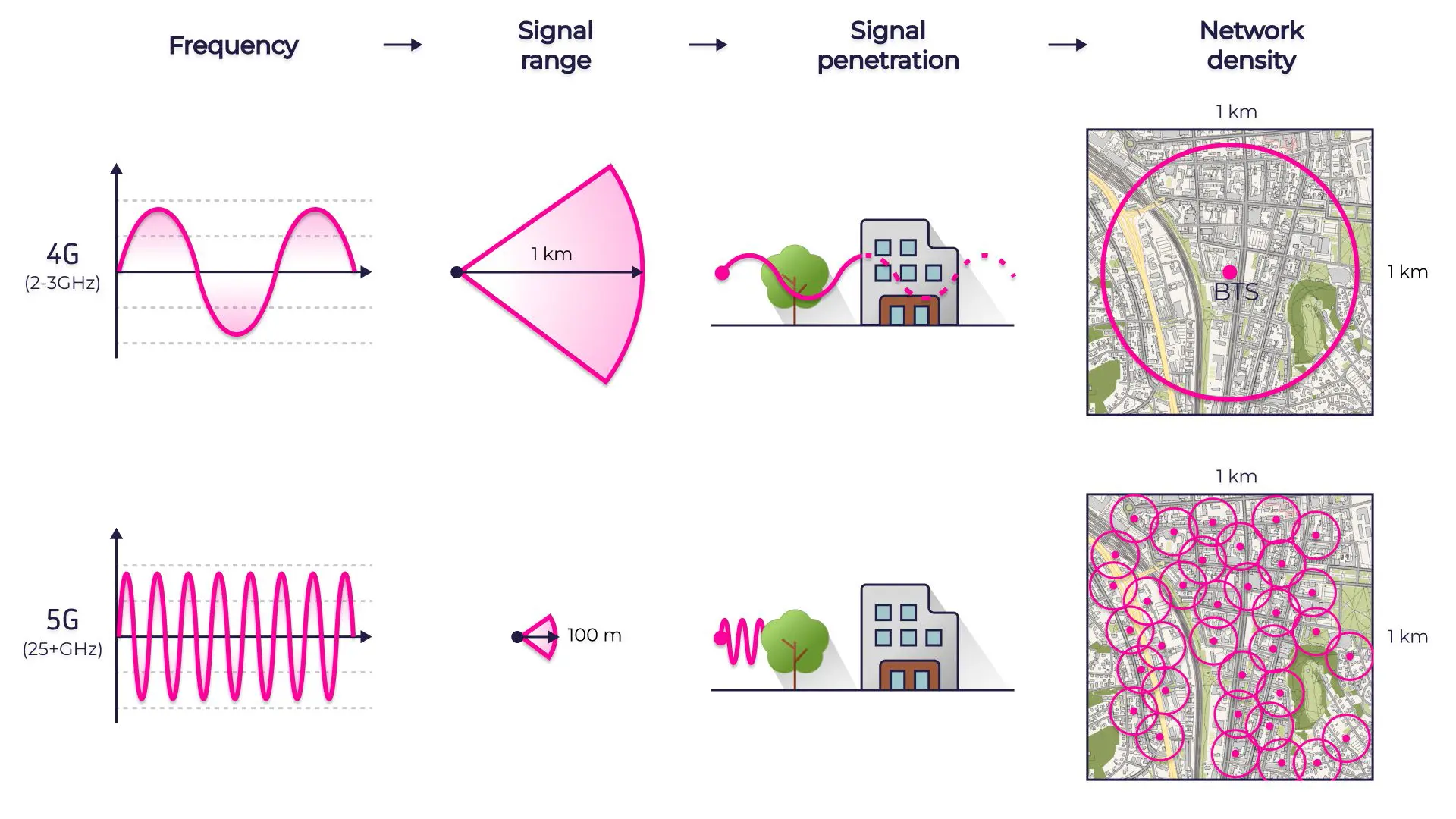
Designing the network topology in Private 5G is fundamentally more complex than in previous generations due to the need for a much denser infrastructure, especially when using high frequency. This requires placing a large number of small cells in close proximity, making spatial relationships and interference management significantly more difficult.
In Private 5G deployments, the number of viable locations for installing base stations and antennas is often highly constrained by physical infrastructure, ownership boundaries, and operational requirements. This means planners must work within a predefined and often suboptimal set of site candidates rather than freely selecting ideal positions.
In Private 5G networks, the physical environment has a direct and often unpredictable impact on signal propagation, especially at higher frequencies such as mmWave. Obstacles like buildings, machinery, vegetation, and even moving objects can significantly attenuate, reflect, or scatter radio signals, making accurate modeling essential.
Private 5G network planning requires processing large volumes of complex data, combining high-resolution 3D environments with advanced radio propagation modeling. The planning must optimize the network configuration to meet performance targets. This involves evaluating numerous network configurations to balance all required parameters.
Designing Private 5G networks requires highly specialized radio planning expertise, particularly when dealing with mmWave frequencies, dense topologies, and complex propagation environments. Such expertise is scarce on the market, which makes it both difficult and costly to assemble and scale qualified engineering teams.
Mistakes in Private 5G network planning can lead to significant financial and operational consequences, as network performance is tightly linked to precise radio design. Inaccurate assumptions about coverage, interference, or capacity may result in coverage gaps or unstable connectivity, directly affecting the reliability of critical use cases.
Automates key stages of the radio network design process, reducing the need for manual configuration and iterative adjustments. Enables faster delivery of planning projects, especially in complex Private 5G scenarios. Supports more consistent and repeatable planning outcomes across different deployment environments.
Uses detailed 3D spatial data such as LiDAR, BIM, and GIS to accurately represent real-world environments. Ensures reliable propagation modelling in dense urban and industrial deployments. Captures environmental factors that are typically missed in simplified or 2D-based planning approaches.
Leverages GPU computing to significantly speed up radio propagation simulations and network optimization tasks. Allows rapid testing of multiple scenarios and design iterations within a short time. Enables handling of large-scale and high-complexity environments without compromising performance.
Designed for high-frequency 5G deployments where signal behavior is highly sensitive to environmental factors. Supports planning of dense network topologies required for reliable mmWave coverage. Helps address challenges related to signal blockage, reflection, and rapid signal degradation.
Enables simulation of network performance in environments with moving objects such as vehicles or machinery. Provides additional validation beyond static planning assumptions. Allows testing of real operational scenarios before actual network deployment.
Reduces reliance on expensive RF planning experts through automation and guided workflows. Makes network planning more accessible to engineering teams with varying experience levels. Helps organizations scale their planning capabilities without significantly increasing team size.
Blare Tech tools have been used in real-world Private 5G planning projects, including infrastructure deployments in complex environments such as transportation systems. The solution supports engineering teams in designing reliable and cost-effective networks under real operational constraints.
GPU-based solution made for AI-powered, automated 5G network radio planning and simulation.
© 2022 Blare Technologies. All rights reserved. Privacy Policy
